
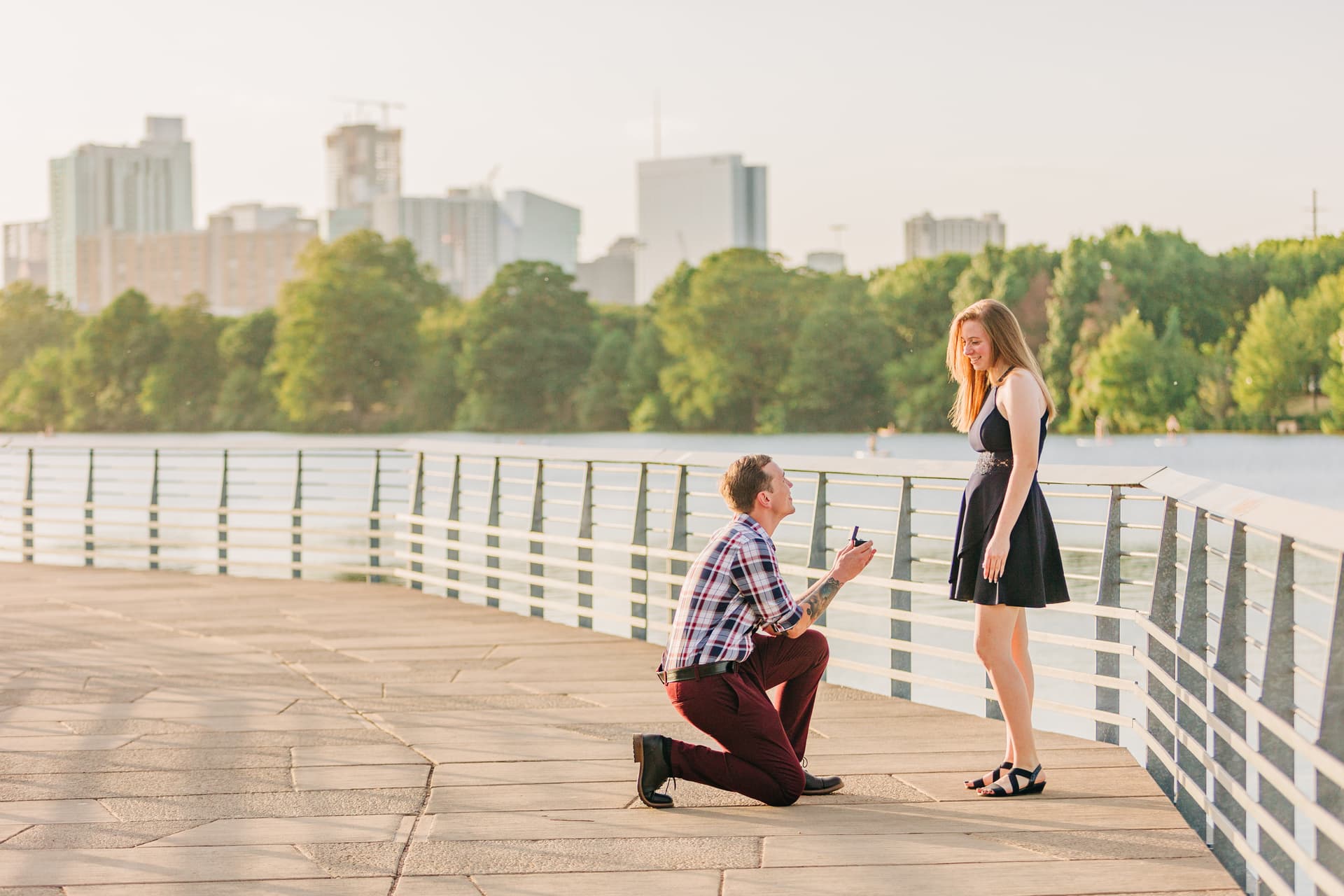
So you want to propose in Austin, and you want it done right. Good news: this city is stacked with spots that make the moment feel like a scene from your own movie. The catch is that the best places to propose in Austin aren't always the prettiest ones. They're the ones where you can actually pull off the surprise without your partner clocking the plan halfway up the trail.
I've crouched behind trees, posed as a random tourist, and once camouflaged myself a hundred feet out with a long lens while a guy got down on one knee. Some of those proposals were elaborate, with coordinated family ambushes. Some were quiet, just the two of them. A couple involved a fast pivot when Plan A fell apart. Here's what all of it taught me: the view matters less than whether you can actually pull off the surprise.
So this is a ranked guide to Austin's proposal spots, sorted less by how they photograph and more by how reliably they work.
What Makes a Great Proposal Spot in Austin
A great proposal spot in Austin comes down to five things, and only one of them is the view. The first is whether it's scoutable, so you or I can visit ahead of time to plan positioning, timing, and backups without raising suspicion. The second is timing you can control, some way to predict when it won't be crowded so your moment doesn't get drowned out by a bachelorette party or a youth soccer team. Third, a backup nearby: if it's pouring or the place is unexpectedly closed for an event, there's a Plan B close by that doesn't blow up the plan. Fourth, somewhere I can hide, because "casually" standing 15 feet away with a camera pointed at you is not subtle. And last, low ambush risk, so your partner won't spot me setting up and no passing tourist yells "ARE YOU PROPOSING?" 30 seconds before you kneel. (Yes, that has happened.)
Run any Austin spot through those five and the real contenders sort themselves out. Here are mine.
The Best Places to Propose in Austin
These are the seven I keep coming back to, ranked by how dependably they hold up on the day.
1. Mount Bonnell (the classic, and it earns it)

Yes, it's the obvious one. Mount Bonnell is a cliché because it works: panoramic views over Austin and Lake Austin, plus a stone staircase that gives you natural stopping points where dropping to one knee looks organic instead of staged. Golden hour, the hour before sunset, is when the downtown skyline starts to glow.
It works because multiple overlook areas let me put you somewhere away from the crowd, and the light does most of the heavy lifting. Go on a weekday, either 8-10am or arriving about 90 minutes before sunset, because weekends are mobbed. The parking lot is small and fills fast, so come early or park on the street and walk up. I'll be at the top overlook first, pretending to shoot the skyline, already in position when you reach the spot we agreed on. If the main overlook is packed, there are quieter side trails, and we'll have a Plan B and C scouted before you ever show up.
2. Mayfield Park & Preserve (peacocks and privacy)

Want something unmistakably Austin but quieter than Mount Bonnell? Mayfield Park is the move. It's a historic West Austin estate with roaming peacocks (real ones, just wandering the grounds), lily ponds, and ivy-covered stone cottages. It feels like a secret garden dropped into the middle of the city.
Why it works: The garden splits into several separate "rooms," so we get privacy and variety in one place, and the cottage architecture makes an easy backdrop. The peacocks are a wildcard in the best way. Sometimes they photobomb the moment perfectly; sometimes they wander off. I always grab shots of you without them too, just in case.
Logistics: Weekday mornings, 9-11am, are nearly empty. Weekends bring families and other photographers but stay manageable. I'll be the person "photographing the peacocks," which is the most normal thing you can do here, with a clear sightline to your chosen spot. If your first-choice garden is taken, there are at least five more equally good ones within a two-minute walk.
3. Laguna Gloria (art on the lake)

Laguna Gloria is the Contemporary Austin's lakeside site: a 12-acre sculpture park and historic villa on Lake Austin. The waterfront lawn is big, the art installations change so it never feels stale, and the 1916 Driscoll Villa gives you architecture without leaving the water. Mature oaks create intimate pockets inside the larger space.
Why it works: There's enough room for me to stay 50-plus feet away with a long lens and still catch everything, and the paid entry keeps the crowd smaller and more intentional than a free park.
Logistics: Grounds admission runs about $5 per person ($1 on Tuesdays, free for ages 18 and under). If I'm shooting, Laguna Gloria requires a professional photography permit, currently $150 an hour, booked at least 72 hours ahead, so this is one to plan early. Worth knowing: that permit is on me if you're already a confirmed wedding client. The grounds close at 5pm, so this is a late-morning or midday spot, not a sunset one. Aim to arrive by 3:30pm for unhurried time. (If sunset light is non-negotiable, go with Mount Bonnell or Auditorium Shores.) I'll buy a ticket and blend in as a visitor photographing the sculptures. One heads-up: check their event calendar, since private events occasionally close off sections.
4. Zilker Botanical Garden (pick your aesthetic)

The Zilker Botanical Garden packs about 28 acres of themed gardens (Japanese gardens, butterfly trails, rose gardens, a tangled woodland) into one spot, which makes it one of the most flexible proposal locations in Austin. You choose the backdrop that fits you. The Japanese Garden and koi pond are the quiet, photograph-anywhere standout.
Several distinct zones mean we can pivot the second one area gets crowded, and the winding paths keep me hidden until the moment. It feels private even though it sits in the middle of Zilker Park. For a professional shoot the garden charges a $50 photography permit, and that permit conveniently covers admission for two people plus me, so your entry is included. There's no advance booking; you can pay at the gate the day of. The best window is weekday mornings, 10am to noon, and it closes at 5pm September through May and 4pm in summer, so it's not a sunset spot. Spring, March through May, has the most blooms, while fall and winter run quieter and more intimate. If your first garden is occupied or closed for maintenance, there are at least six other areas to use.
5. Auditorium Shores and Doug Sahm Hill (the skyline shot)
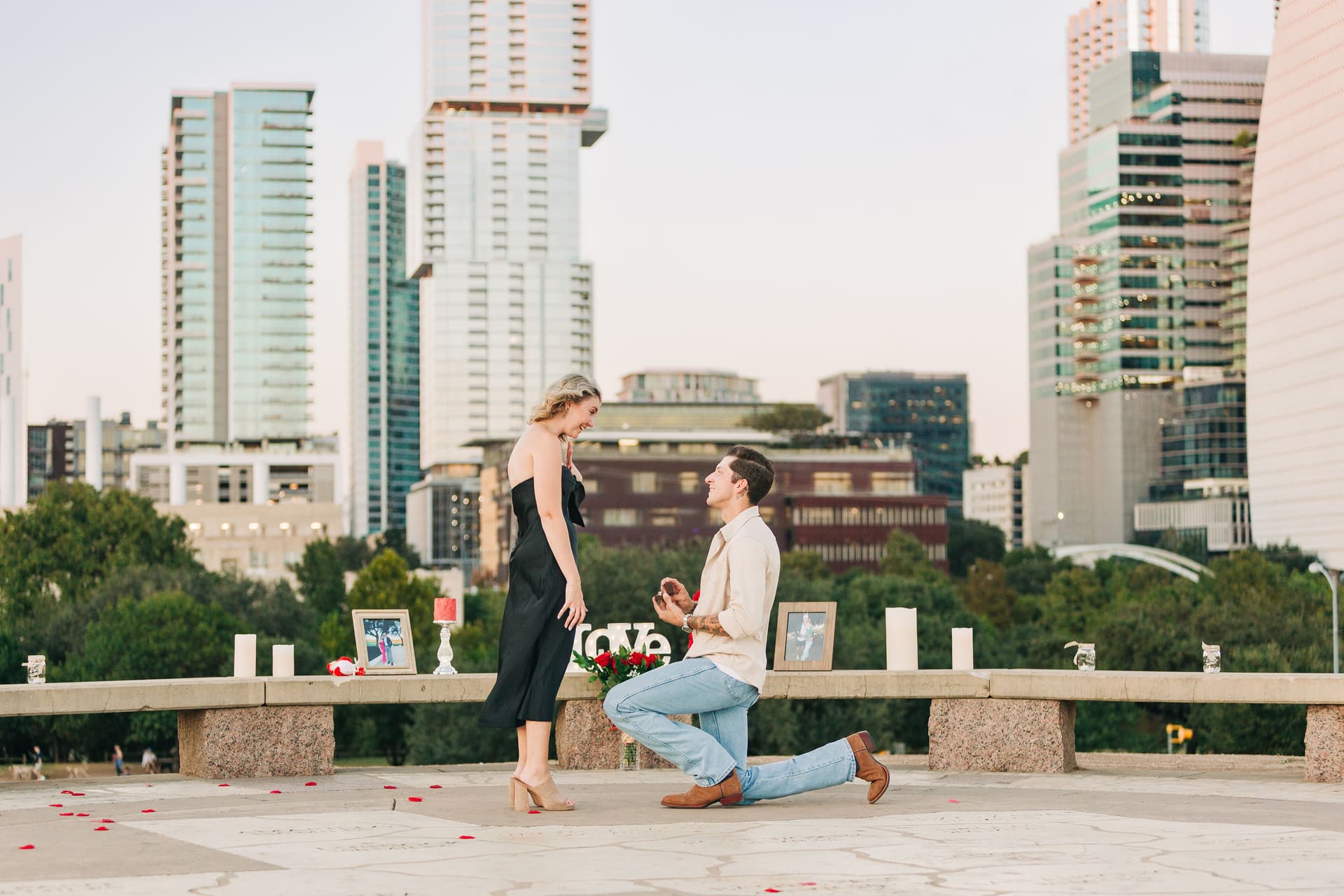
Auditorium Shores hands you the postcard: the Austin skyline reflected in Lady Bird Lake, the shot that says you got engaged here. For an elevated version, climb Doug Sahm Hill, the small landscaped rise inside the park, for a near-360 view from above the main lawn. It's free and open to the public, no tickets.
Why it works: The skyline is unobstructed, the lawn is huge so spacing away from other people is easy, and multiple trail access points give me flexible angles.
Logistics: Weekday mornings (8-10am) or the 90 minutes before sunset. Skip weekends and evenings, when the trail fills with runners, dog walkers, and paddleboarders. I'll set up on a bench "photographing the skyline," which nobody here thinks twice about. Fair warning: this is a high-traffic area, so we'll coordinate timing to cut down on background photobombs, but you won't have total privacy. Some couples love the energy; others want seclusion. Know which one you are. If the park is closed for a festival, which happens during SXSW and ACL, we can pivot to the Pfluger Pedestrian Bridge or the Boardwalk Trail east of there for a similar skyline.
6. McKinney Falls State Park (drama, inside the city)

Want real nature without leaving Austin? McKinney Falls State Park is a 641-acre state park in southeast Austin: limestone ledges, two waterfalls on Onion Creek (when there's been rain), old-growth cypress, and wide creek-side space. It feels remote and adventurous while sitting minutes from downtown.
Why it works: The falls and smooth limestone ledges make genuinely dramatic backdrops, and the open terrain lets me hang well back with a long lens.
Logistics: Day-use is about $6 per person (13 and up; kids 12 and under free). On weekends and holidays the park can hit capacity, so reserve a day pass online to guarantee entry and parking. The gate stays open until 10pm, which means this one, unlike the gardens, does work for a golden-hour or sunset proposal. One physical note: the limestone near the water gets uneven and slippery, especially after rain, so flat, grippy shoes are smart. That's tricky to enforce on a surprise, so plan the walking route around it.
7. A restaurant or private dining room with a view

Not every proposal belongs outside. A restaurant or private dining room with a real view is one of the most reliable options here, precisely because weather can't touch it. Two Austin favorites:
- The Oasis on Lake Travis, billed as the "Sunset Capital of Texas," with tiered decks looking straight over Lake Travis and an upper viewing deck that's a classic proposal perch.
- Quince Lakehouse, upscale waterfront dining on Lake Austin in the former Abel's on the Lake space, with a patio right over the water. I shot a proposal in the private dining room here, and the view did half my job for me.
It's weatherproof, a private room gives you full control over timing and seating, and you're already somewhere lovely for dinner afterward. Staff at these places have seen plenty of proposals and will quietly help you pull it off. Call ahead: many venues will hold a specific table or a private room, sometimes with a food-and-beverage minimum, and if you tell them you're proposing they'll usually tuck you into the best-view seat in the house. Sunset reservations at the lakeside spots book up fast, so lock one in early. Indoor low light is trickier to shoot than open daylight, so I'll plan my settings around the specific room ahead of time. In a private room I can pose as another guest along the wall; in a public dining area I'll coordinate with the host to sit nearby with a clear line.
What If the Right Spot Is Somewhere Personal?
Sometimes the best spot isn't on any list. Some of my favorite proposals happened nowhere near a public overlook. I once shot one at the top of a downtown high-rise still under construction. My client was on the build team, so it was the most personal backdrop imaginable, and no scenic vista could have meant more.

The rooftop where you had your first date, your own backyard, the trailhead you hike every weekend, a lake house you rent for a weekend: if a place tells your story, it usually beats a postcard view. Bring it to me and we'll work out the light, the logistics, and the hiding spots together. If you plan to shoot engagement portraits right after, my guide to Austin engagement photo locations has more backdrops worth folding in.
How Does Proposal Photography Work Without Ruining the Surprise?
It comes down to a planning call with you, never your partner, then a location we scout in advance so I can blend into the background with a long lens on the day. Here's the whole thing.
The planning call (just you)
Before the big day, we map every detail on a call. We pick the exact spot, the best time, and the contingencies. I'll show you photos of where I'll be standing so you know which way to face. We sort out how to stay in touch day-of without your partner seeing messages; most people route it through a friend or a second email. We build a loose timeline with buffer room in case you're running late or the moment doesn't happen right away. And we war-game the "what ifs": someone's standing in your spot, it starts raining, they say no. (Nobody has yet. We plan for it anyway.)
Day-of coordination
Give me a heads-up when you're 15 to 20 minutes out. I arrive early, lock in the lighting and positioning, and blend in as a tourist or nature photographer. You walk up "casually" with your partner, head to the agreed spot, and I'm already set with a long lens.
One small thing that helps enormously: if you can sneak a quick selfie of what you're both wearing that day, without tipping your partner off, send it over. In a busy spot, knowing your exact outfits lets me pick you out of a crowd and track you from a distance without ever looking like I'm watching. (Since you'll probably shoot portraits right after, it's worth a look at what to wear for engagement photos while you're planning outfits anyway.)
When you propose, I'm capturing the drop to one knee, their reaction (usually the keeper), and the first hug as an engaged couple, plus the candid celebration after.
Then one of two things happens. Either I reveal myself and we do a 15-to-30-minute engagement portrait session right there while the adrenaline's still up, or I stay hidden and leave you a fully private moment with candid-only photos. Most couples take the portrait session. You're already dressed up, the location's scouted, and that emotional high makes for some of the best photos you'll ever take. You can see how those turn out in my couples portfolio.
Delivery
Sneak peeks land within 48 hours, a handful of images so you can announce on social. The full gallery follows in about two weeks, 50 to 100 photos depending on whether we shot a portrait session after.
How Much Does a Proposal Photographer Cost in Austin?
In Austin, proposal photography generally runs from a few hundred dollars up to $900 or more, depending on coverage and the photographer's experience. My own packages start at $400.
Proposal + Mini Engagement Session, $400 covers the pre-proposal planning consultation and location scouting, covert coverage of the moment itself, a 15-minute mini engagement session right after while the happy tears are still flowing, sneak peeks within 48 hours, and the full edited gallery within two weeks.
Proposal + Full Engagement Session, $700 is everything above plus a full-length engagement portrait session immediately after: more variety, multiple spots within the location, room for an outfit change, and a larger final gallery. It's the move if you want to knock out your engagement photos the same day you get engaged.
At $400 for the initial investment, and $700 for the full length session, my packages sit on the accessible end of that range, not because the work is any lighter but because I'd rather make capturing this moment easy to say yes to. Hiring an Austin proposal photographer buys you more than the pictures, though the pictures matter plenty. You get someone who's done this 50-plus times, knows these locations cold, and can troubleshoot the logistics you haven't thought of yet. Full package details live on my pricing page, and yes, there's a payment plan: the $700 package books with a 50% deposit, with the balance due the week before.
Proposal Questions I Get Asked Most
"What if they figure it out?"
Most people are so locked into the moment that they never notice me. I shoot with a long lens (70-200mm) so I can stay 50 to 100 feet back, dressed and acting like a tourist or nature photographer, which is completely normal at every spot on this list. If your partner is unusually observant, tell me, and we'll plan even more carefully and put me further out.
"What if it rains?"
We'll have a plan. Most of these outdoor spots don't work in bad weather, so if the forecast turns we've got two good moves: reschedule to another day (no rescheduling fee for weather) or pivot to a weatherproof restaurant or private dining room with a view. We decide together based on how much your timeline can flex.
"What if someone's already in our spot?"
We'll have two or three backups scouted inside the same location, and I'll have walked you through them in advance. Plan A's taken, you drift to Plan B, and nobody's the wiser.
"Which spot should I pick?"
On our planning call I'll ask about your relationship, your partner's personality, and the vibe you're after, then give you the honest pros and cons. Torn between two? That's exactly the conversation I'm here for. And if you're weighing Austin against the rest of the state, it holds its own on any list of the best places to propose in Texas.
Ready to Plan Your Proposal?
I've shot proposals at every location here and a dozen more around Austin. If you're getting ready to pop the question and want someone in your corner who's done this plenty of times, let's talk. Get in touch or start with my couples and engagement services, and we'll pick the perfect spot, map the logistics, and make sure the moment gets captured exactly the way you're picturing it.
Related: